 Ventilation is a way of expelling polluted air and replacing it with
fresh air from elsewhere.
Ventilation is a way of expelling polluted air and replacing it with
fresh air from elsewhere.Ventilation is a way of expelling polluted air and replacing it with
fresh air from elsewhere.
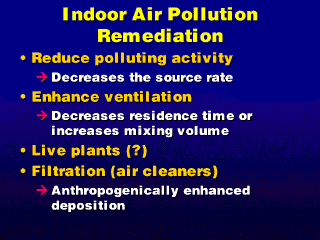
Live plants are thought to
filter air through the soil (it is not a result of the plant giving off oxygen
gas--the amount of oxygen added to a room is negligible compared to the amount
of indoor air that might be able to pass through the soil and get filtered).
However, the Environmental Protection Agency (EPA) has refuted the scientific
studies showing the filtering effects of plants, noting that the laboratory
conditions are not comparable to actual living spaces. It would take enough
plants to pretty much cover all the floor space in a room before the room could
be cleared of air pollutants. Thus, plants have a more aesthetic effect on a
room rather than accomplishing any practical level of air filtration.
 Filtration systems use a mesh of fibers to trap solid
aerosol particles while allowing air molecules to pass through. The smaller
the openings between the fibers, the smaller the particles that can be filtered
out. High-Efficiency Particle Air (HEPA) filters are currently the rage.
These are paper fiber filters that are woven so tight that only particles less
than about 0.1-0.3 micrometers can pass through (a more conventional paper fiber
filter may pass particles as large as 3.0 micrometers). Newer Ultra-low Penetration Air (ULPA) filters only allow a very small amount of particles with diameters of 0.1 micrometers to pass.
Filtration systems use a mesh of fibers to trap solid
aerosol particles while allowing air molecules to pass through. The smaller
the openings between the fibers, the smaller the particles that can be filtered
out. High-Efficiency Particle Air (HEPA) filters are currently the rage.
These are paper fiber filters that are woven so tight that only particles less
than about 0.1-0.3 micrometers can pass through (a more conventional paper fiber
filter may pass particles as large as 3.0 micrometers). Newer Ultra-low Penetration Air (ULPA) filters only allow a very small amount of particles with diameters of 0.1 micrometers to pass.
Fiber or mechanical filters, by design, allow gas molecules to pass through. So they cannot filter out air pollutants that occur as gases, such as formaldehyde and carbon monoxide. A sorbent is a chemical that can remove pollutant gas molecules, either by a chemical reaction or by an adsorption technique. The latter occurs when a certain gas molecules preferentially stick to the surface of the sorbent materials.
Granulated Activated Charcoal
(GAC) consists of carbon particles that have been puffed up, much like popcorn,
so their surfaces are very rough and the particle is somewhat spongy in structure.
The rough surface provides a lot of surface area for gas molecules to stick
to, and the activation process actually changes the charcoal so that it attracts
molecules that are not nitrogen, oxygen, carbon dioxide, or water/water vapor
(this is why charcoal filters work in water filtration also). Zeolite
is a mineral that acts very similarly to activated charcoal, except its internal
crystalline structure is much more open than GAC. This allows us to "recharge"
the zeolite by heating it with sunlight for a day, which drives the collected
gas molecules out. You would have to heat GAC to 600F for a few hours to accomplish
the same thing.
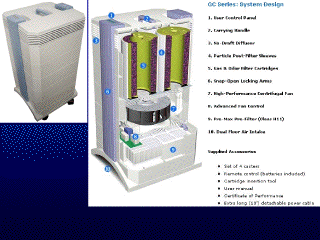 This is the Swiss-made IQAir
filtration unit, one of the more effective (and expensive) particle and gas
filtration units available to consumers. Use only if you need really serious
filtration, since replacing the multiple filters may cost an average of $100-200/year.
This is the Swiss-made IQAir
filtration unit, one of the more effective (and expensive) particle and gas
filtration units available to consumers. Use only if you need really serious
filtration, since replacing the multiple filters may cost an average of $100-200/year.

